Noun (Basic ㊦ 191)
A thing which is intangible.
Equivalent: Thing; what
| (i) {V/Adjective い} informal | こと | |
| {話す /話した} こと | What someone (will) says/said | |
| {面白い /面白かった} こと | What is/was interesting | |
| (ii) Adjective な stem | {な/だった} こと | |
| {大事な/大事だった} こと | What is/was important | |
| (iii) Noun | のこと | |
| 先生のこと | Things about the teacher |
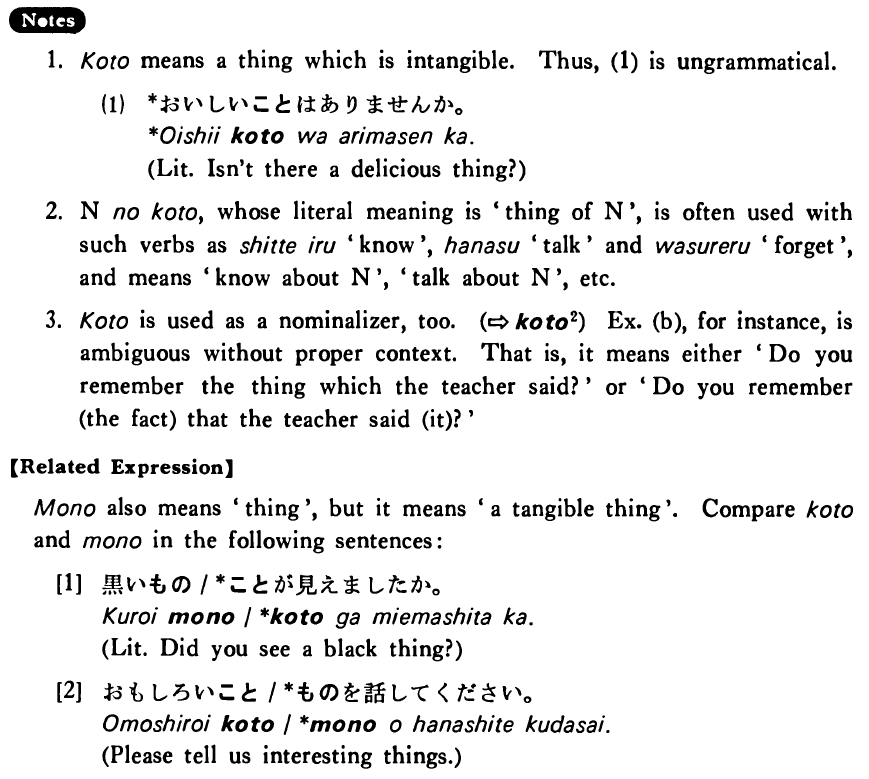
1. こと means a thing which is intangible. Thus,(1) is ungrammatical.
2. Nounのこと, whose literal meaning is 'thing of Noun' is often used with such verbs as 知っている 'know', 話す 'talk' and 忘れる 'forget', and means 'know about Noun', 'talk about Noun', etc.
3. こと is used as a nominalizer, too. (⇨ こと2) Example (b), for instance, is ambiguous without proper context. That is, it means either 'Do you remember the thing which the teacher said?' or 'Do you remember (the fact) that the teacher said (it)?'
【Related Expression】
もの also means 'thing', but it means 'a tangible thing'. Compare こと and もの in the following sentences:
[1]
[2]